
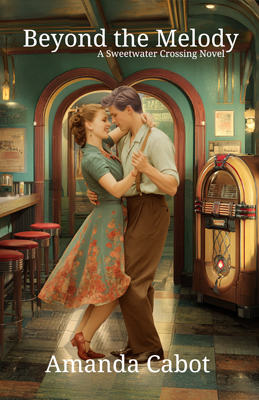
A Sweetwater Crossing Novel
Publication Date: July 2026
ByDand Publishing
ISBN 978-1-62454-076-9
Beyond the Melody
Return to Sweetwater Crossing for another story of hope, healing, and happily-ever-after
Beyond the Melody is Amanda Cabot at her best! Reading is My Superpower
This heartwarming, satisfying story stole my heart, and I highly recommend it. Interviews & Reviews
I would give Beyond the Melody ten stars if that was an option. A Goodreads Reader
If you've read the earlier Sweetwater Crossing books, did you ever wonder what life was like for the Vaughn sisters' descendants? I did.
If you've read one of the many excellent novels set during World War II, did you ever wonder about life after the war ended? I did.
Beyond the Melody answers those questions and more.
As you might expect, in 1946 many things were different from the 1880s. Can you imagine how shocked the Vaughn sisters would be to see Anna wearing such a short skirt? What would they think if they heard an automobile driving down the street? And, of course, there were no radios, telephones, or jukeboxes in the nineteenth century.
The list goes on and on.
Can you tell that I had a lot of fun researching the post-war era and bringing it to life for you? I certainly did, and so I invite you visit Sweetwater Crossing in 1946.
Available in paperback, as an ebook, and on Kindle Unlimited exclusively at Amazon

Want to Know More?
Neither one is looking for love,
But sometimes all it takes is one dance.
By the spring of 1946, life in Sweetwater Crossing is almost back to normal after the war. Not Anna Finley's. She lost her chance at happily-ever-after when the man she loved was killed in France. Anna does her best to hide her sorrow and a secret that haunts her as she works on the jukeboxes she inherited when her brother died in combat. There's no point in dreaming about what might have been.
Jim Smythe is also grieving a shattered life. His fiancee broke their engagement, reminding him that a respected magazine said it should take no more than three weeks for a veteran to forget the war. But Jim cannot forget the men in his platoon who didn't return home, and he's made it his mission to visit each of the fallen soldiers' families, hoping to give them some small measure of comfort. Sweetwater Crossing is his final stop. After that, he'll have to return to Boston and the life that holds no appeal. If only he could find an alternative, one where people saw him for himself, not his family's name.
He's given up hope that anyone will understand what his parents and fiancee did not, but everything changes when he enters a small cafe and sees a woman whose eyes reflect his own pain standing next to a jukebox. Jim knows he'll never see her again, yet it somehow feels right to extend his hand and say, "May I have this dance?"
It's a once-in-a-lifetime moment for two wounded people unless they can overcome their fears and find the courage to love again.